Sara Jones
Interview of Sara Jones by François-Xavier De Costerd
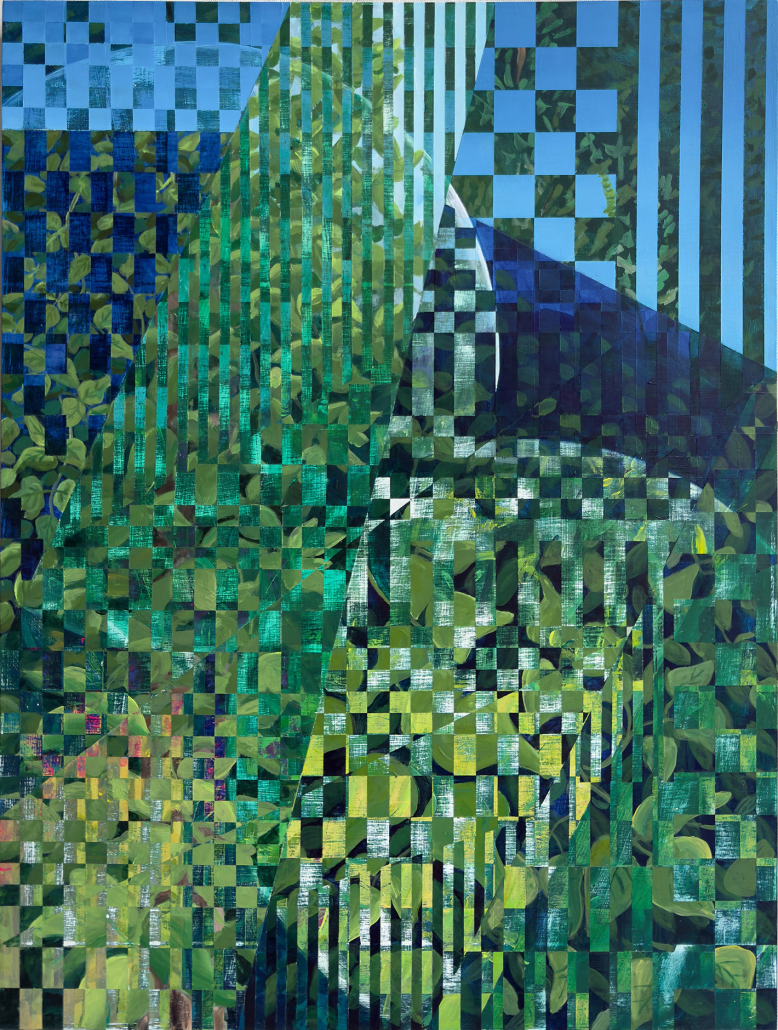
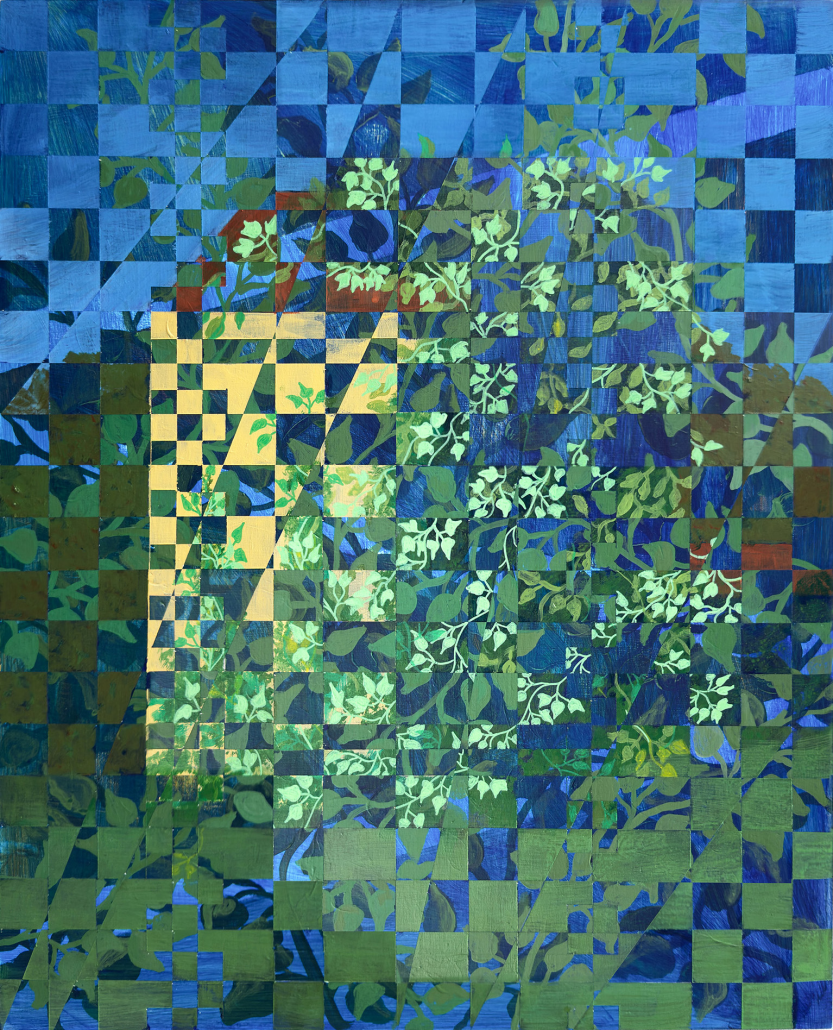
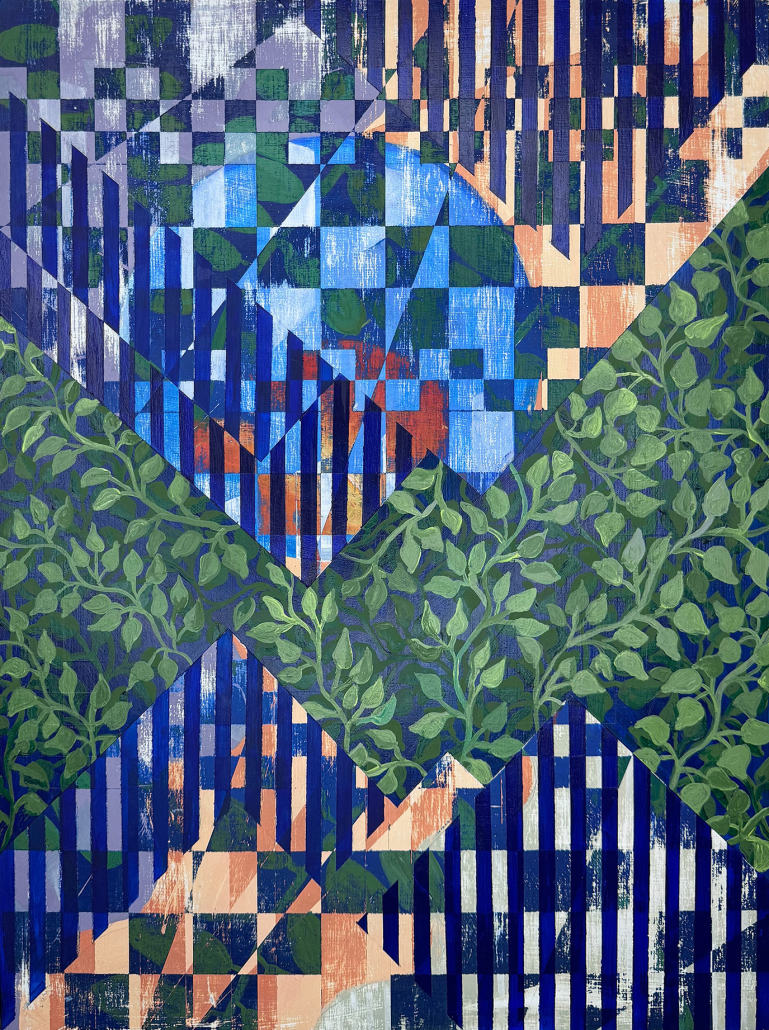
Sara Jones is a painter whose current body of work is inspired by the ecological landscape of Southern Alabama, where she grew up, and uses irregular and interrupted layered grids to question the destructive choices of capitalist exploitation in the face of endangered species, extinction threats, and habitat loss.
François: I realize I really don’t know much about you even though we were in the same graduating show at SMFA 20 years ago. Where were you born and raised? When you came to grad school what had you been up to before?
Sara: I was born in Indianapolis, IN and raised in Mobile, AL. I went to college in Connecticut, and after college moved to NYC to work as a graphic designer for a magazine. I did that for two years before deciding to apply to grad school. I took a year to work on my portfolio and moved to Providence, RI during that time. I was accepted to the Post-Baccalaureate program at the Museum School and enjoyed that so decided to stay for my MFA.
François: What was your childhood like?
Sara: I grew up in Mobile, AL and had a pretty good childhood. We spoke German at home because my mom is German, so that was a bit of a novelty in southern Alabama. I have 2 sisters and we grew up on a street with lots of children, so we were always outside and running back and forth between houses. Every other summer we would travel to Europe to visit family, and in the other summers we would travel somewhere in the US. My parents were both professors/teachers, so they had summers off. We did two big western trips and some trips up the east coast, as well. Travel was important and a big part of my learning experience growing up.
François: You work in the city but you live out in New Jersey, what are the cultural differences that you’ve experienced between these two places?
Sara: Not many…my suburb is only 30 minutes away by train and most people who live in my town once lived in the city. Our community is fairly diverse and vibrant and I appreciate that we’ve found a place to live that gives us the opportunity to work and have the cultural vibrancy of NYC so close.
François: What does your professional work entail?
Sara: I work as the Director of Design and Creative Strategy at Public Art Fund. Public Art Fund is a non-profit organization that brings dynamic contemporary art to a broad audience in New York City by mounting ambitious free exhibitions of international scope and impact that offer the public powerful experiences with art and the urban environment throughout the city in parks, airports and other public spaces. As the Director of Design, I am responsible for our visual identity and branding, creating exhibition graphics, institutional branding, and marketing campaigns across different media, and I recently led the project to redesign our website, which archives over 500 exhibitions from our near 50-year history.
François: Have you always lived in the Northeast/New York area or have you lived elsewhere in the U.S. or other countries?
Sara: I grew up in Mobile, AL and lived in Germany for my 2nd grade year and part of my 8th grade year, while my dad was doing research as part of his sabbaticals. I went to college in Connecticut, and lived in NYC, Providence, Boston, and back to NYC. I now live in New Jersey.
François: When I was in grad school with you, I was a young single dad. Now that you have become a mother, how does that experience of motherhood and family life influence your work or the way you work?
Sara: It’s a juggle, especially also working full time. Things I think about in my studio practice have also become more poignant and fraught as the mother of child who is growing up in this time. I have a series of paintings that I started in 2020 that I refer to as my “pandemic paintings.” They are works that responded to the pandemic, what was happening in politics and current events at the time, as well as grappling with my own situation as a working mother of a young child. Overall, motherhood is a constant source of inspiration while also being the thing that challenges me more than anything.
François: This exhibition emerges from nearly two decades of sustained conversation and critique with the same group of artists. What does a long-term artistic relationship make possible that a short-term collaboration cannot?
Sara: This group and the relationships we’ve formed are so special because we’ve known each other’s work from when we were all just starting out and forming our artistic identities. It’s rewarding to be able to chart the growth of everyone’s practice and also see what threads remain from those early stages. Knowing those origins helps us guide each other in teasing out what really matters in each of our practices.
François: You have mentioned taking mini-residencies with another mom in the group, Andrea. Could you say how this came about and what came out of those experiences?
Sara: We started doing this 3 years ago. We had started another mini-crit group with another mom/artist friend of ours during the pandemic and I think we were all struggling in our practices a bit being moms of young children while cooped up 24/7. We dreamed of getting out of the house for a few days to clear our heads and think about our work in a sustained bit of time. We finally decided to just try it—we would rent a house midway between our cities and spend 3 full days focused on our practices. We would work all day and then come together in the evening to discuss. It proved to be a very good, generative, and necessary jumpstart for each of us, and we decided to make it an annual tradition over President’s day weekend.
François: The title of our show Here, Still suggests both presence and persistence. What does it mean, for you, to remain, with a place, a question, or a group of collaborators?
Sara: Ultimately, being an artist requires presence and persistence. It is important to have fellow artists who understand that and can be there to hold you accountable or help you understand and distill what you are working on or thinking about in the studio. It is incredibly valuable to have a group of collaborators who are constant and consistent and ask good questions that keep you going and your practice sustained.
François: In your own practice, how has time, especially the extended time of experience, functioned as a material?
Sara: My work has always dealt with memory in some way and I am fascinated by how memory shifts over time and is colored by different experiences. My current body of work in essence is a return to my memories of a place, the place where I grew up and the environment that was formative to my understanding of place. It’s interesting to revisit the specifics of a place (the plants, the smells, the weight) from such a distance and with such disparate experiences since.
François: How has sustained dialogue with other artists shaped the way you see your own work?
Sara: I am grateful that there are other artists who have a long-standing view of my practice and have seen my experiments and my failures. It’s important to have people you can be vulnerable with and test creative boundaries with—through going through that process with you they are able to help you push your practice forward. I do see my work more clearly because of that process and it’s helped me distill my priorities over time.
François: What does a productive critique look like to you now, and has that changed over time?
Sara: A productive critique is one where the group has a certain understanding of what you were working on and what questions you were trying to answer and helps you determine how successful you were. I think it’s important to have conversations with both artists who are familiar with your work over time, and artists who are new to your work. Each brings a different set of perspectives and questions and I think both are critical to moving a practice forward in a productive way.
François: Has this continuity influenced your risk-taking or experimentation?
Sara: Yes. I think I am braver about bringing new experiments to the group and this has helped me figure out the parts of my practice that really resonate and stick.
François: Are there moments from the group, conversations, critiques, or even disagreements that have stayed with you or shifted your thinking in a lasting way?
Sara: There was one thing that was said about a year ago that sent me on the path of my current body of work and I am still so grateful for it. Someone said “Go very deep on one particular thing and through doing that reach the essence and level of abstraction. It’s not so much obscured as winnowed down–the essence of a single thought. Be solidly there and nowhere else.” That was really helpful and I am still working on distilling that through my process in the studio.
François: What role does listening play in your practice, both in the studio and in the critique space?
Sara: Listening is very important. I often prefer to listen to first impressions and gut reactions rather than giving a background or spiel about the work. Especially when I am hoping that the work resonates both formally/aesthetically as well as conceptually, I often want to hear what those reactions are because they are more useful sometimes than me explaining something.
François: Has being part of this group changed how you approach looking at other artists’ work?
Sara: Any type of sustained critical thinking helps hone that skill over time, and the conversations that this group has had about individual artworks, practices, and our relationships as a group has really influenced how I look at work in general. Sustained “listening” or looking is so important to honoring the work of other artists and it allows for a deeper and more nuanced understanding.
François: Looking back, what has been most meaningful to you about our time together as a critique group?
Sara: The time and the shared experience of having all started in a grad program that fostered and allowed for experimentation across media. We all have such varied practices and I think that grounding at the Museum School did provide a valuable skill set in being able to successfully understand and talk across media and techniques to focus on a deep conceptual understanding of what we are all trying to do.
François: What do you think makes a creative community endure?
Sara: Commitment to showing up and the reward of the conversations that come from that.
François: Your work often deals with abstraction as metaphors for very real and tangible concerns. How would you describe your practice to someone encountering it for the first time?
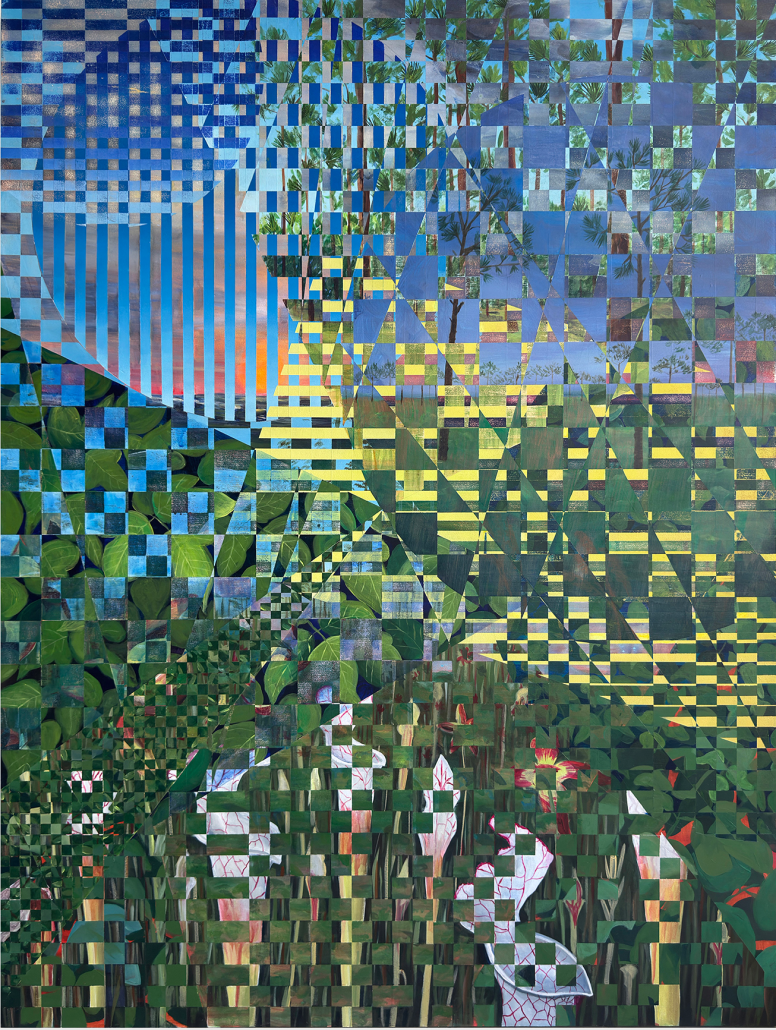
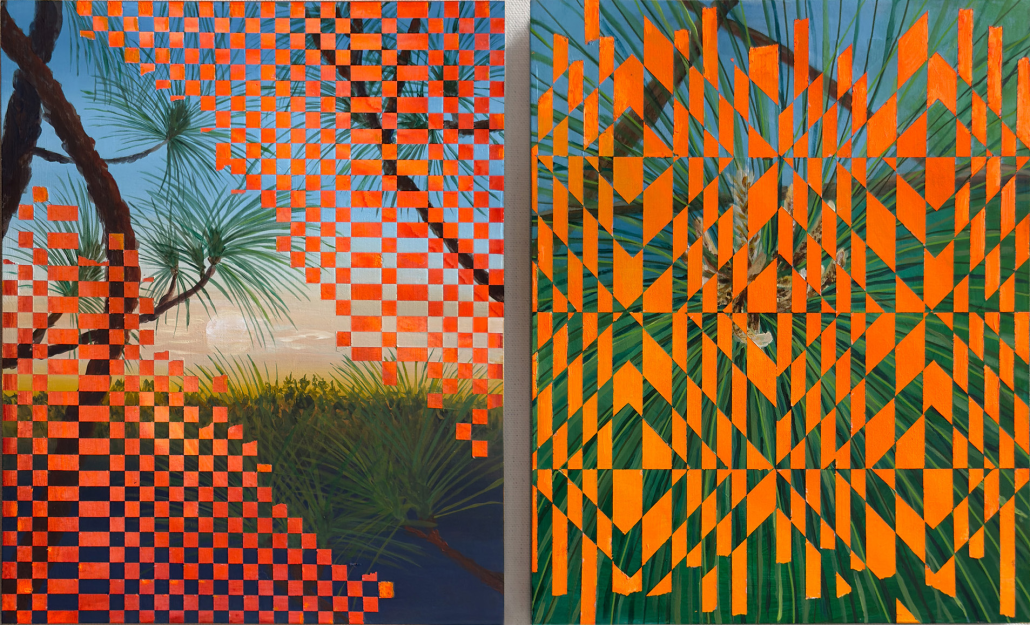
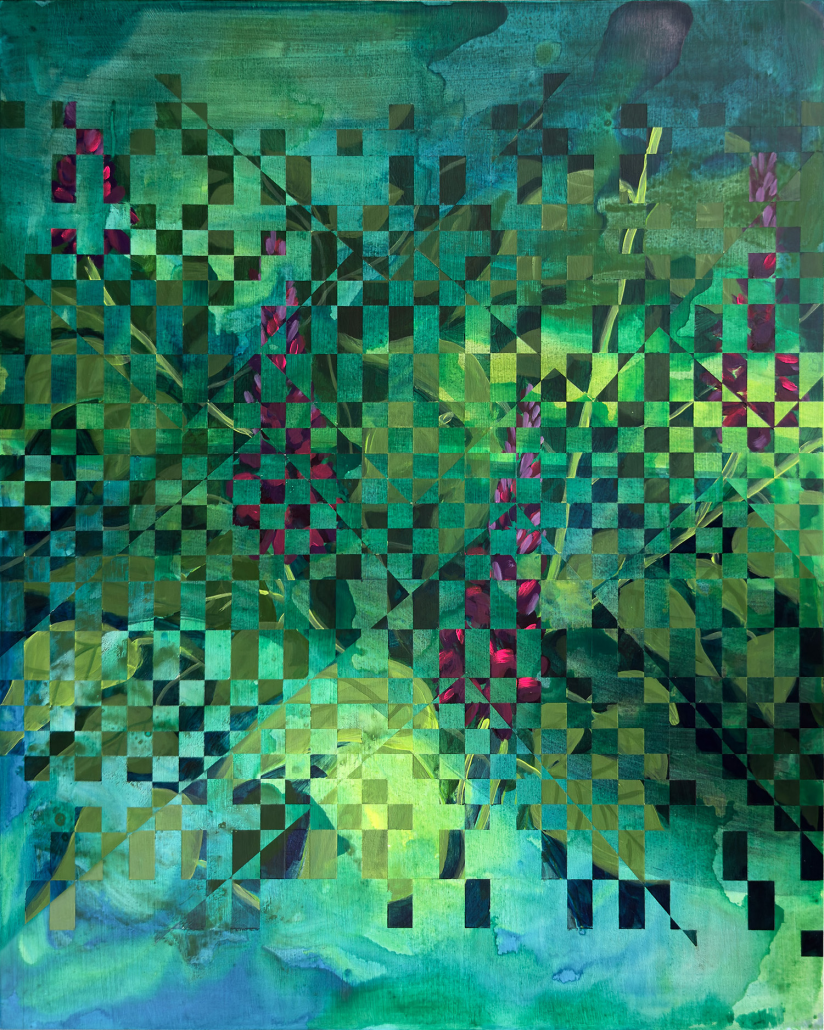
Sara: I am a painter, and in my most recent body of work, the paintings are inspired by the ecological landscape of Southern Alabama, where I grew up, and use irregular and interrupted layered grids to question the destructive choices of capitalist exploitation in the face of endangered species, extinction threats, and habitat loss. Through the repetitive act of painting, masking, painting again, and peeling, I cede control of what layers are exposed or in focus, creating an anxiety akin to the one I have in trying to reckon with America’s history and the continued degradation of our planet.
François: What questions or urgencies are currently driving your work?
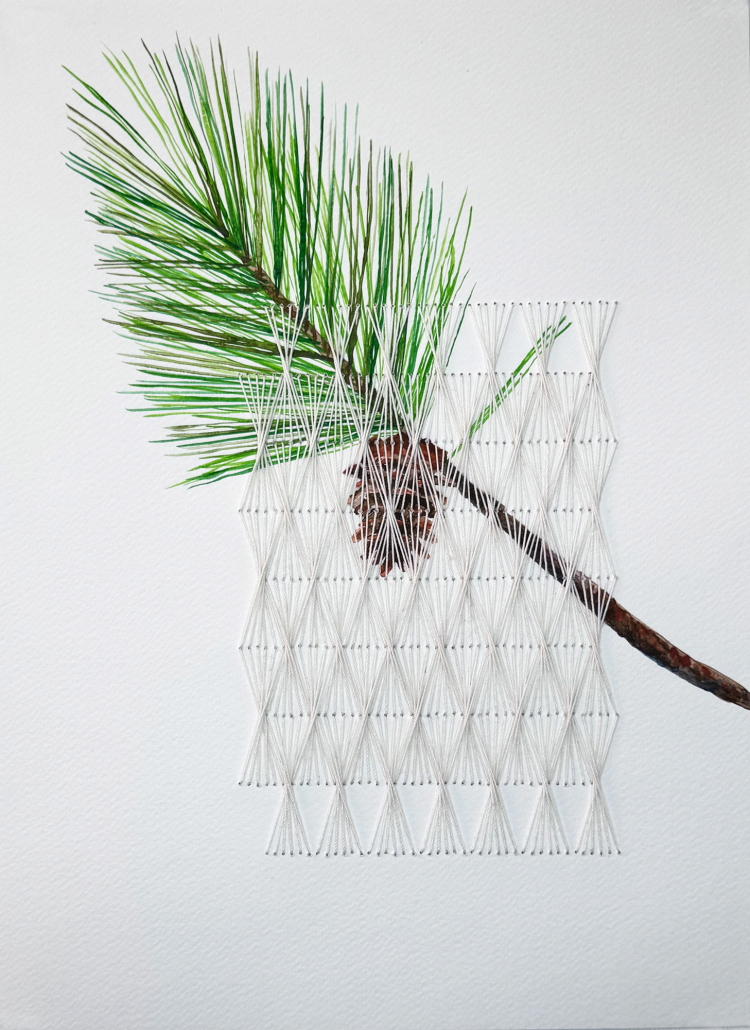
Sara: I am interested in grappling with the potential of painting, especially certain formal choices of color, composition and abstraction, to bear the weight of and be a metaphor for larger existential questions and our collective relationship to our fraught shared histories. The formal repetition of the grid within my work is one I have been using for a long time, and it is a literal reference to weaving (the warp and weft, which alludes to the way we talk about narratives and history: we “weave stories” and “connect the threads”), yet it also metaphorically references a screen, or scrim: something that allows some things to flow through, but prevents others from entering or crossing the boundary. The literal and metaphoric grid signals both object and action, a physical screen and the process of screening: we screen calls, we choose what we want and don’t want to cross the border into our house, our country, our threshold, our consciousness. At the moment, my subject matter focuses on the dichotomy between two plants that had an outsize impression on me as a child growing up in the South: the native Southern Long Leaf pine (Pinus palustris), and the introduced Kudzu vine (Pueraria montana). These merge with personal memories that influence the color and shapes within the work, and allow me to hold space for a hope and potential of healing.
François: Many of your paintings involve concerns around biological, technological, or environmental issues. What does your process actually look like day-to-day in the studio or out in the field?
Sara: A combination of research and process. Sometimes my research leads me towards a clear vision of what I want my painting to become, however more likely is sketching, experimentation or diving right in. Sometimes the only way I can resolve a painting is by starting something and seeing where it takes me. Since I have so little actual studio time, I don’t spend as much time sketching and experimenting as I would like to, but I always try to work through a couple of small studies on paper before I dive into the final piece.
François: How do you curate your materials to start a painting like the source image?
Sara: These days my subject matter revolves around 2 specific plants (The Longleaf pine and the Kudzu vine), so I have been collecting photos and images of those plants to use as source material. A lot of these photos come from family snapshots, but I also find images in magazines, books, and online. I also do sketches and take notes about colors and compositions that I am interested in exploring and refer to those during the process of beginning a new painting.
François: Do you see your work as a form of witnessing, questioning, or something else entirely?
Sara: Yes, both, but it’s more about questioning. I am interested in the fallibility of memory, and use the fracturing in my work to hint at that.
François: Your work often takes away as much as it adds to the image. How do you make those substitutions legible or tangible?
Sara: There is usually one source image that starts off or inspires a painting. I usually do a very rough underpainting, and then I start to think about what shapes I want to bring in (the shapes act as a visual metaphor of ideas or things I am thinking about), and I begin to mask out parts of the composition. Over that I paint the next layer of the painting. These days it’s usually a plant or specific landscape–I like to move between zoomed out landscape and details of specific plants in the different layers of the paintings. Once the new layer is resolved and finished and dried, I hold my breath and I peel off the tape and it reveals a new interpretation of the work (since I am literally removing half of what I just painted). From there the process is very intuitive in terms of layering new shapes/grids/masks and choosing what I want to obscure or reveal. Sometimes I will sand off areas of the painting to allow for some of the underneath painting to reemerge, and then I’ll paint a new grid or layer on top of it. It is a push and pull process and it becomes more intuitive the further along I get. It’s about lack of control–the paintings feel very precise and controlled, but each time I peel away half of a layer, I am completely ceding control with no real idea of what to expect or what will be revealed.
François: Has your relationship to the natural world changed through your work?
Sara: It has made me more curious about everything—especially about understanding the relationships that exist in the world between plants, between plants and insects and animals, and how we as humans inflect everything we do with a self-centeredness yet without a lot of thought to how our actions create ripple effects that can have detrimental effects on the world around us. I want to learn everything I can about the natural world around me, and wish I had paid better attention in science class.
François: What are you paying attention to right now that you weren’t five years ago?
Sara: I am moving through the world differently…more like a botanist or scientist and trying to notice things around me.
François: What feels at stake in your work today?
Sara: I feel like my work is just a processing of the bigger stakes of everything that is going on around us. I do think the work of artists is critical to helping all of us form an understanding and reflect critically on what is happening politically, environmentally and socially all around us, but I think the stakes of all of that are so much bigger than the stakes of my individual artistic practice. If my practice can help influence someone else’s thinking in a positive way that propels some sort of action, then that is all I can hope for.
François: What are you working toward next?
Sara: Continuing this body of work and making some more large paintings to experiment with scale.